
Colostrum for Ulcerative Colitis & Crohn’s: What the Research Shows
Colostrum for Ulcerative Colitis & Crohn's: What the Research Shows
Bovine colostrum is marketed hard for inflammatory bowel disease. So I read everything that has actually been published on it. Here is what the evidence genuinely supports, where it runs out, and what a year of taking ARMRA alongside ordinary gut care did and did not do for me.
Real results.
A balanced look.
The bottom line in
30 secondsThree cards. If you read nothing else on this page, read these.
What we know
One small human trial found a colostrum enema improved symptoms and biopsy findings in left sided ulcerative colitis, on top of mesalazine. Colostrum does contain immunoglobulins, lactoferrin and growth factors, and it reduces damage in animal colitis models.
What we don't know
Whether swallowing colostrum does anything at all for IBD. No trial has ever tested oral colostrum for efficacy in inflammatory bowel disease. Nothing is known about remission, about Crohn's specifically, or about whether the proteins survive digestion.
What that means for you
Treat colostrum as an experiment, not a treatment. Keep taking what you have been prescribed, tell your gastroenterologist before you add it, and set a stopping point in advance. At a gram or two a day you are far below any dose ever studied.
- Grass fed US dairy
- Cold chain, low heat processing
- No added hormones
- Unflavoured and mixes cold
Every study, ranked against the bar it would need to clear
Five lines of evidence, plotted by how close each comes to establishing colostrum as a treatment for inflammatory bowel disease. None of them reaches it.
nothing closes
Bar height is how close each line of evidence comes to demonstrating benefit in IBD. The tallest is a fourteen person trial that used a rectal enema. Everything above the dashed line is territory no published study has entered.
Showing all 6 studies
Human trial2002n = 14Ulcerative colitisRectal route
Khan and colleagues: colostrum enema in distal ulcerative colitis
ResultPositive, and extremely limited. Symptom scores improved 2.9 points against 0.5 worse on placebo.
View studyHide study
Adults with distal, left sided ulcerative colitis, mean age 45. Both arms stayed on mesalazine at 1.6 g per day; the colostrum group added an enema, the control group an albumin enema. Histological improvement was seen in 5 of the 8 people who received colostrum.1
Fourteen people, delivered straight onto inflamed tissue rather than swallowed, added to an existing drug rather than replacing it, and never replicated in more than twenty years.
Human trial2022n = 23Crohn's diseaseOral, 20 g daily
Allen and colleagues: oral colostrum in paediatric Crohn's disease
ResultNo difference from placebo on symptoms, laboratory markers or quality of life. Not powered to find one.
View studyHide study
Median age 15.2, Crohn's in remission or mild to moderate. Six weeks blinded against a matched milk powder, then six weeks open. Completion was 75.0 percent on colostrum and 81.8 percent on placebo, and 58.3 percent were still taking it at three months.2
This asked whether children would take it, not whether it worked. The authors state the small sample prevented any assessment of clinical or laboratory benefit.
Review202422 trials1,427 patients1 on IBD
Hajihashemi and colleagues: systematic review of colostrum in gut disease
ResultOnly one of 22 trials addressed IBD. Most carried a high risk of bias and the data could not be pooled.
View studyHide study
Doses, outcomes and populations varied so much that the data could not be pooled. Most included studies carried a high risk of bias, which the authors say seriously weakens confidence in the results.3
This is the field auditing itself and reporting that the field is thin.
Mechanism202410 trialsNot IBD
Hajihashemi and colleagues: meta analysis of intestinal permeability
ResultSmall reductions in gut permeability markers, in athletes and general patients. Heterogeneity 99 percent.
View studyHide study
Oral colostrum was associated with small reductions in the urinary lactulose to rhamnose and lactulose to mannitol ratios, the standard laboratory measures of how leaky the gut lining is.6 This is the best support the barrier idea has.
Heterogeneity of 99 percent means the ten trials disagreed with each other almost completely. No IBD population was included, and a permeability ratio is not a flare, a biopsy or a medication requirement.
Mechanism2021Narrative review0 oral IBD trials
Sienkiewicz, Szymańska and Fichna: the reference review on colostrum in IBD
ResultPositive on mechanism and animal models. States plainly that no oral efficacy studies in IBD patients exist.
View studyHide study
It walks carefully through immunoglobulins, lactoferrin, growth factors and antimicrobial peptides, and through animal colitis models where colostrum does reduce damage. Then it says: there are currently no investigations pertaining to the efficacy of oral bovine colostrum supplementation in IBD patients.4
Animal colitis is induced chemically over days. Human IBD is a relapsing immune condition lasting decades. The two do not transfer cleanly.
Company data2023n = 602 g dailyNo control group
ARMRA internal report: the source of the marketing percentages
Result86 percent reported less bloating. Open label, unpublished, and nobody in it had IBD.
View studyHide study
This is where 86 percent experienced less bloating and 79 percent reported digestive relief come from. It is a real observation about how people felt. It is not evidence that the product caused it.11
Everyone knew what they were taking, there was no placebo arm, it has not been peer reviewed, and it did not include anyone with inflammatory bowel disease.
No studies of that type.
The one positive human trial, and why it does not mean powder works
This is where the only encouraging result in the whole literature lives. The detail that changes its meaning is the one most articles leave out.
Left sided colitis was chosen for that trial precisely because an enema can reach it. Nobody has tested whether the oral route does the same thing, in colitis or anything else. Until somebody does, this study supports a delivery method almost nobody uses.
It is also worth knowing that the people who read this literature professionally are not enthusiastic. Reviews describe the evidence base as small and at high risk of bias,3 and the Cleveland Clinic's own dietitian has said publicly that she does not see enough science to recommend bovine colostrum at all.9
One study, and it was never designed to answer the question
Crohn's and ulcerative colitis get filed together as IBD, but they behave differently enough that evidence in one tells you very little about the other.
What this study can tell us
- Young people with Crohn's will take colostrum powder daily
- Roughly six in ten stick with 20 g a day for three months
- A proper efficacy trial is feasible and, the authors argue, warranted
What it cannot tell us
- Whether colostrum helps Crohn's. It was never powered to find out
- Anything about adults, or about active severe disease
- Whether a smaller supplement sized dose would do anything at all
So the correct summary is not that colostrum failed in Crohn's. It is that the only study was too small to detect anything and was never trying to. Anyone telling you colostrum helps Crohn's is going beyond the evidence. Anyone telling you it has been disproven is going beyond it too.
If you have not been diagnosed with IBD, this is probably the wrong page for you. Bloating, cramping and irregular digestion without visible inflammation point toward IBS, where the evidence and the practical advice are both different. I have written that up separately in colostrum for IBS, with broader context in the gut optimization guide. If you have bloody stools, unexplained weight loss or persistent fever, that is a reason to see a doctor rather than read more supplement articles.
The barrier pathway, one step at a time
This is the story behind every colostrum gut claim. Step through it and you can see exactly where the hypothesis sits, and how much of the chain is still unproven. Select any stage.
A healthy gut barrier
A single layer of epithelial cells, sealed together by tight junctions and covered by mucus, separates roughly forty trillion microbes from your immune system. Secretory IgA coats the surface and binds bacterial products before they get close.
When this is working, the immune system in the gut wall stays quiet. Nothing in this stage is controversial, and nothing here involves supplements.
The barrier becomes leaky
Tight junctions loosen, the mucus layer thins, and permeability rises. In laboratory terms this is measured by giving someone sugars such as lactulose and mannitol and seeing how much crosses into the urine.
This single step is where the entire colostrum hypothesis lives. Colostrum contains immunoglobulins that bind bacterial products, lactoferrin that sequesters iron away from microbes, and growth factors including TGF beta that encourage epithelial repair.4
The human data supporting even this one step comes from athletes and general patients rather than anyone with IBD,6 and it pooled with 99 percent heterogeneity. In inflammatory bowel disease it is still an open question whether barrier disruption causes the inflammation or results from it. If you want the mechanism in full, I have written it up in the science behind colostrum and the gut lining.
The immune system meets what it should not
Bacterial fragments and food antigens that would normally stay in the gut lumen reach immune cells sitting in the wall beneath. Those cells respond as if to an infection.
No colostrum trial has measured this step in people with IBD. Everything known about it here comes from animal models and from human research in other conditions.
Inflammation takes hold
Cytokine signalling recruits more immune cells, which release more signals. In inflammatory bowel disease this loop becomes self sustaining, which is why IBD is treated with drugs that interrupt specific immune pathways rather than with anything nutritional.
Colostrum reduces inflammatory damage in animal models of chemically induced colitis.4 No trial has shown it lowering an inflammatory marker or an endoscopic score in a person with IBD.
Tissue damage and symptoms
Sustained inflammation produces ulceration, bleeding, urgency, pain and fatigue. This is the level at which a treatment has to prove itself: a change in a symptom score, a biopsy, a calprotectin result, a medication requirement.
Only one colostrum study has ever measured outcomes at this level in IBD, and it delivered colostrum rectally to fourteen people.1 That is the entire distance between an interesting mechanism and a demonstrated treatment.
Six things colostrum cannot do for IBD
Not legal boilerplate. These are the specific claims I see made online that the published research does not support.
Replace your IBD medication
The Crohn's and Colitis Foundation is explicit that complementary approaches sit alongside prescribed treatment, never instead of it, and that you should not stop a medication because you started a supplement.10 In the one trial where colostrum helped, everybody was also taking mesalazine.1
Induce or maintain remission
No study has tested this. Remission is a defined clinical endpoint measured with scoring systems and endoscopy, and nobody has ever run colostrum against it.
Be treated as proven for Crohn's
The only Crohn's study found no difference from placebo and was too small to have found one if it existed.2
Be relied on to survive digestion
Whether colostrum's bioactive proteins survive stomach acid and enzymes in a useful form is still contested.4 The colitis trial sidestepped the question entirely.
Be assumed safe for everyone
ARMRA's own label carries a Contains: Milk declaration. Cleveland Clinic advises anyone with a cow's milk allergy to avoid bovine colostrum, and reported side effects include nausea and gas.9
Be assumed consistent between brands
Testing 20 commercial colostrum products found a sixfold difference in biological activity between the most and least active.8 Heating to between 50 and 60 degrees for an hour cut activity by more than 40 percent while the proteins still showed up on a standard assay, so a label can look right when the product is not. That is a quality argument for choosing carefully, not a clinical argument for colostrum working.
What a year of ARMRA actually did for me
Everything above this point was measured by somebody. Everything below it is one person's account, which is the weakest form of evidence there is.
Nothing disappeared. There was no week where symptoms simply stopped, and nothing I could point to on a test result.

I do not have inflammatory bowel disease. I have dealt with ongoing gut sensitivity and IBS type symptoms, not ulcerative colitis or Crohn's. My experience cannot tell you what colostrum does in an inflamed colon, and I am not going to pretend otherwise. It is here because I took the same product for a year and you reasonably want to know what happened, not because it generalises to your diagnosis.
- My gut felt more stable overall
- Flare ups felt less disruptive, though not eliminated
- Recovery after digestive stress felt smoother
- My immune system felt more resilient through the year
- I removed my own trigger foods over the same year
- I protected sleep and managed stress deliberately
- I walked every day
- Any one of those could explain the whole thing
The full breakdown, including the unremarkable parts, is in my one year ARMRA review. The immune side of that year, which is the part I noticed most, is written up separately in colostrum for cold and flu.
Why ARMRA is the colostrum I use
A product choice is not a medical claim. Here is the honest version of both halves.
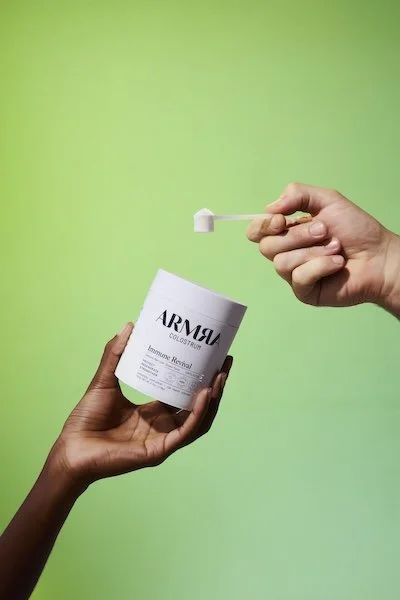
Given how much products vary, processing is the thing worth caring about. The 20 product analysis found a sixfold spread in biological activity and showed that even moderate heat destroys that activity while leaving individual proteins detectable on paper.8 So low heat processing and sourcing are the questions I would put to any colostrum brand.
ARMRA uses a low temperature, cold chain process and sources from grass fed US dairy cows, taking surplus colostrum after calves have fed. That is a reason to prefer one colostrum over another. It is not evidence that colostrum treats IBD, and I want those two claims kept apart.
For sourcing, bioactives and how colostrum is used outside a gut context, the background sits in the complete ARMRA colostrum guide.
- Low temperature processing, which the bioactivity research says matters
- Clear sourcing, taken after calves have fed
- Mixes cold without clumping, which is why I stayed consistent
- No casein or lactose, though it is still a milk product
- The headline percentages come from ARMRA's own uncontrolled survey
- A 2 g serving is far below any dose studied in IBD
- The price is high for something with no IBD efficacy data
- No independent bioassay of the finished product has been published
Standard jar, 120 servings. Roughly a dollar a day at the label's suggested intake.
People without IBD who want a well processed colostrum and understand they are running an experiment on themselves.
Anyone with active IBD hoping to reduce medication, anyone with a cow's milk allergy, and anyone whose budget this would strain.
If you have read all that and still want to try it
Talk to your gastroenterologist first, keep taking whatever you have been prescribed, and treat colostrum as an experiment rather than a treatment. If you go ahead, this is the one I use.
Five questions worth asking your gastroenterologist
Questions people actually ask
Drawn from what readers search for, answered against the same evidence base as the rest of the page.
Is colostrum good for ulcerative colitis?
There is one small positive trial, and it does not support the colostrum powder most people buy. A randomised, double blind study in 14 adults with left sided ulcerative colitis found a colostrum enema improved symptom scores by 2.9 points against 0.5 worse on placebo, with histological improvement in 5 of 8 people. Everyone stayed on mesalazine.1
The colostrum was delivered rectally, straight onto inflamed tissue, and the trial has not been replicated in over twenty years. No study has tested oral colostrum for efficacy in ulcerative colitis. Colostrum is not an approved or established treatment for the condition.
Can you take colostrum if you have Crohn's disease?
It was generally tolerated in the only Crohn's study, but there is no evidence it helps, and you should ask your specialist first. Twenty three young people with Crohn's took 20 g of colostrum powder daily for twelve weeks. Symptoms, laboratory markers and quality of life were similar to placebo, and 58.3 percent were still taking it at three months.2
The authors state the study was too small to assess efficacy, so this is an absence of evidence rather than evidence of absence. Because IBD usually means ongoing medication, raise it with your gastroenterologist before adding it.
Does bovine colostrum help IBD?
Current human evidence is not strong enough to show that oral bovine colostrum treats inflammatory bowel disease. A 2024 systematic review of 22 trials and 1,427 patients found exactly one study addressing IBD, judged most included studies to be at high risk of bias, and could not pool the data.3
The reference review in Advances in Nutrition puts it plainly: there are currently no investigations pertaining to the efficacy of oral bovine colostrum supplementation in IBD patients.4 Colostrum may be worth exploring as a supportive experiment, alongside and never instead of prescribed treatment.
Can colostrum help during an ulcerative colitis flare?
No study has tested colostrum during an active flare, so there is no evidence either way. The one positive colitis trial recruited people already on maintenance mesalazine and ran for four weeks; it was not a flare rescue study.1
A flare is the point at which IBD needs medical attention rather than a supplement. Bloody stools, unexplained weight loss, persistent fever or worsening pain are reasons to contact your IBD team, not to start something new on your own.
Does colostrum heal the gut lining?
It may modestly reduce gut permeability in people without IBD, which is not the same as healing the gut lining. A 2024 meta analysis of ten randomised trials in athletes and general patients found small reductions in the urinary sugar ratios used to measure how leaky the lining is, with heterogeneity of 99 percent, meaning the trials disagreed almost completely.6
No IBD population was included, and a permeability ratio is not a biopsy, a flare or a medication requirement. The mechanism is covered properly in the science behind colostrum and the gut lining.
What dose of colostrum has been studied for IBD?
Far more than a standard supplement serving, and by a route most people do not use. The Crohn's study used 20 g of powder daily, reduced to 10 g where that was not tolerated.2 The colitis trial used a 100 mL enema of a 10 percent solution twice daily, roughly 10 g per dose delivered rectally.1 ARMRA's own survey used 2 g daily.11
If you are taking a gram or two a day, you are well below every dose that has been studied in inflammatory bowel disease. That does not prove a low dose cannot work; it means nobody has tested it.
What are the side effects of bovine colostrum, and who should avoid it?
Reported side effects are mainly digestive, and anyone with a cow's milk allergy should avoid it entirely. Cleveland Clinic notes nausea and gas among reported effects and advises against bovine colostrum for people with a cow's milk allergy.9 Colostrum is a dairy product and ARMRA's own label carries a Contains: Milk declaration.
Tolerance also drops over time at research doses: only 58.3 percent of participants in the Crohn's study were still taking 20 g a day at three months.2 If you have IBD, are pregnant, or take immune modifying medication, check with your clinician before starting.
Can colostrum replace IBD medication?
No, and no evidence supports reducing prescribed treatment because you have started a supplement. The Crohn's and Colitis Foundation is explicit that complementary approaches sit alongside prescribed treatment rather than instead of it, and that you should not stop a medication you have been prescribed.10
It is worth noting that in the single trial where colostrum showed benefit, every participant was also taking mesalazine.1 The colostrum was added to a working treatment, not substituted for one.
Is ARMRA Colostrum good for ulcerative colitis or Crohn's disease?
No colostrum product, ARMRA included, has been shown to help ulcerative colitis or Crohn's disease. ARMRA's headline figures come from a company run, open label survey of 60 people taking 2 g daily for twelve weeks, with no control group, no peer review, and nobody with IBD in it.11
What the research does support is that colostrum products differ enormously. Testing 20 commercial products found a sixfold difference in biological activity, and moderate heat destroyed activity while proteins still showed up on a standard assay.8 That is a reason to care about processing if you are buying colostrum at all, not a clinical reason to buy it. The full product decision is in my one year ARMRA review.
11 sources, every one linked
- Khan Z, Macdonald C, Wicks AC, et al. Use of the 'nutriceutical', bovine colostrum, for the treatment of distal colitis. Aliment Pharmacol Ther. 2002;16(11):1917. PMID 12390100
- Allen SJ, et al. Dietary Therapy to Improve Nutrition and Gut Health in Paediatric Crohn's Disease; A Feasibility Study. Nutrients. 2022;14(21):4598. PMC9655551
- Hajihashemi P, et al. Therapeutics effects of bovine colostrum applications on gastrointestinal diseases: a systematic review. Syst Rev. 2024. PMC10898101
- Sienkiewicz M, Szymańska P, Fichna J. Supplementation of Bovine Colostrum in Inflammatory Bowel Disease: Benefits and Contraindications. Adv Nutr. 2021;12(2):533. PMC8009748
- Karakülah YS, Yalçıntaş YM, Bechelany M, Karav S. Clinical Applications of Bovine Colostrum in Gastrointestinal Disorders. Int J Mol Sci. 2025. PMC12608013
- Hajihashemi P, et al. Bovine Colostrum in Increased Intestinal Permeability in Healthy Athletes and Patients: A Meta-Analysis of Randomized Clinical Trials. Dig Dis Sci. 2024;69(4):1345. PMID 38361147
- Rathe M, et al. Colostrum Therapy for Human Gastrointestinal Health and Disease. PMC8228205
- Playford RJ, Cattell M, Marchbank T. Marked variability in bioactivity between commercially available bovine colostrum for human use. PLoS One. 2020;15(6):e0234719. DOI 10.1371/journal.pone.0234719
- Cleveland Clinic. Bovine Colostrum: Benefits and Side Effects. Beth Czerwony, RD, LD. health.clevelandclinic.org
- Crohn's & Colitis Foundation. Complementary and Alternative Medicine. crohnscolitisfoundation.org
- ARMRA Internal Report, 2023. Effects of a Proprietary Colostrum Concentrate on Gut Health and Overall Well-being: A Twelve-Week, Parallel-Group Study. Open label, 60 participants, not peer reviewed. Figures as published on armra.com


Disclosure. Some links on this page earn a commission if you buy through them, at no extra cost to you. It does not change what the research says, and it did not change anything written above.